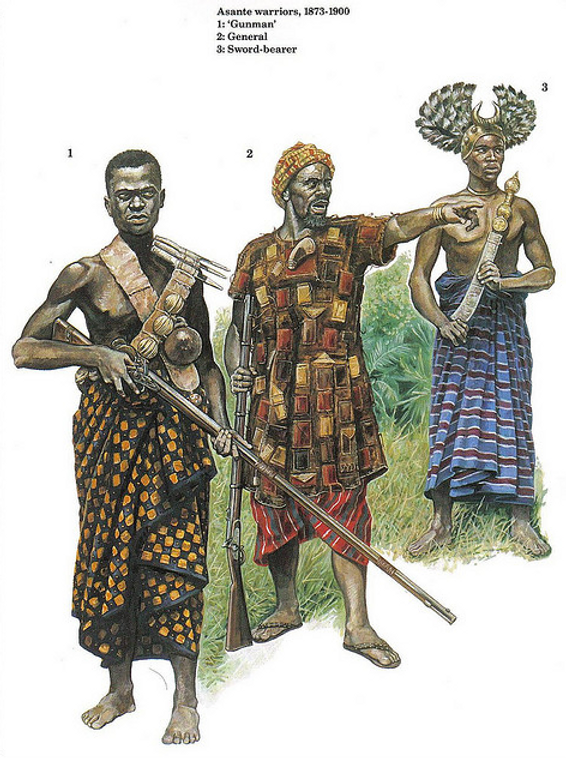
The Ashanti (or Asante) are the dominant ethnic group of a powerful 19th-century empire and today one of Ghana’s leading ethnic groups, with more than two million members concentrated in south-central Ghana. The Ashanti Empire was a pre-colonial West African state that emerged in the 17th century in what is now Ghana.  The Ashanti are an ethnic subgroup of the Akan-speaking people, and the last group to emerge out of the various Akan civilizations, composed of small chiefdoms. Twi, dialect of the Akan language spoken in southern and central Ghana by several million people, mainly of the Akan people, the largest of the seventeen major ethnic groups in Ghana. Twi has about 17–18 million speakers in total, including second-language speakers; about 80% of the Ghanaian population speaks Twi as a first or second language and it is spoken by over nine million Asante people also as a first or second language. Twi has[…]
The Mandé people are a unique ethnolinguistic group originating from West Africa. The term “Mande” covers a linguistically and historically related group of peoples sharing an extremely rich and vibrant historical background, the high point of which was the Mali Empire that flourished from the mid-13th to the early 15th century. Various Mande languages form a branch of the Niger-Congo language family, (Mandinka, Mandingo, Mende, Malinke, Maninke, Susu, Bambara, and Dyula). The heartland of Mande territory is in what is now northeastern Guinea and southern Mali, but Mande people are found across a much larger portion of sub-Saharan West Africa, speaking various dialects of the Manding family of languages. Recognized linguistic groups include the Maninka of northeastern Guinea and southern Mali, the Bamana of Mali, the Mandinka of Senegambia and Guinea-Bissau, the Mandingo of northern Liberia, the Kuranko of Sierra Leone, and the Dyula of northern Côte d’Ivoire. The Soninke provides a[…]
Within the loop of the Niger River in Mali, between the town of Mopti and the Burkina Faso border, there is a place where steep cliffs at the edge of an arid plateau dominate a sandy plain. Over 500 meters high in places, the escarpment is fissured with deep ravines, where rain caught in the cracks of the grey rock supports the growth of dense and varied vegetation. This is the Land of the Dogon. The Dogon, who today number about 300,000, are of the Malinke (Mandingo) ethnic group. Their ancestors are thought to have fled from the Mali Empire under the reign of Sundiata Keita in the fifteenth century and found refuge at the Bandiagara cliffs, where they displaced another people, the Tellern, who left behind abundant evidence of their own cultural traditions in tombs set in caves in the rock face. The communities at the site are essentially[…]
Libraries are a treasure trove of stories, history, and a collection of books that you will not find anywhere else and a perfect embodiment of the importance of books in our lives and why reading matters. Many of them look fabulous and loom over their surrounding locations, as if to say, “This is what really matters.” They are also the perfect juxtaposition of the old books with the new and the combination form the best perfume and a sensation that you may not find anywhere else. If you are crazy enough you can travel to Dubai and visit the perfume man who creates the perfume smell of the things we love. Wouldn’t that be an experience in and itself even though it sounds wildly crazy? If you have ever visited a library on a  warm summer’s day then you may encountered a book that you have never seen or[…]
Our Summer in Africa series is back. A series we started last year with the aim of highlighting some of the most interesting and best experiences in Africa. So as many of our customers are getting ready to ride the trolley to travel and roam anyone two, or more of the 54 countries in the continent, join us as we explore and uncover some of the best experiences Africa has to offer. The African continent teems with unique landscapes, ancient history, diverse cultures and traditions, geographical wonders, and of course wildlife and countless active adventures. So are the stories and tales and fables about legends and most importantly the writers and authors bringing into light these stories. It pays to embark on journeys that fundamentally reorient our senses on our travels. Because part of growing, and learning to travel well, means daring to take our own interests a bit[…]
As some of us are planning and getting ready to rode the trolley to travel and roam the world only this time with much caution and precaution. It pays to embark on journeys that fundamentally reorient our senses. All of us have equivalents. Things we care about that aren’t mentioned anywhere. And part of growing and learning to travel well, means daring to take our own interests a bit more seriously rather than following the hype. So, what is the traveler’s mindset? Receptivity, appreciation and gratitude might be its chief characteristics. Museums are a great place to start especially in getting to know a country better but most importantly it’s history people and culture. According to the most commonly cited figures from a 2007 UNESCO forum, 90% to 95% of sub-Saharan cultural artifacts are housed outside Africa. Many includes works from Benin that were taken during the colonial period and ended[…]
They are considered to be the most revered, fearless, disciplined courageous, and novelty in our modern history. So why haven’t we heard much about them? History is often told through the lens of conquerors indeed. However, that is gradually changing as we begin to little by little uncover the truth about much of African history that was intentionally made to be obscure; and the story of the Dahomey Amazons is one of many examples. After France seized what is now southern Benin in 1894, colonial officers disbanded the territory’s unique force of women warriors, the Dahomey Amazons opened new classrooms and made no mention in the curriculum of the Amazons. Even today, many in the country know little about the Amazons. They are the inspiration for the Dora Milaje, the all-female special forces unit in the Marvel film Black Panther. The Dahomey Amazons were frontline soldiers in the army of the Kingdom[…]
The month of March is Women’s Month. A celebration of women’s contributions to history, culture, and society. In light of this, we are celebrating a few women from the African diaspora whose immense contributions although, often overlooked should live on in perpetuity. And so we continue with a woman who is fearless, a fierce warrior of Africanism, and an advocate of African history, Africa’s story, a writer and storyteller, best known for her themes of politics, culture, race, and gender. She’s also a wordsmith a gift that she has honored to the fullest and precisely the kind of woman we need today in our modern era — who is not afraid to tell it like it is. She’s truly a remarkably inspirational woman and if you are among the lucky few lucky enough to read her work then you know she’s really the voice we need especially in a society that[…]
Mansa Musa or Kankan Moussa (c. 1280 – c. 1337) came to the throne as the 10th ruler of the Mali Empire one of the largest and wealthiest empires the world has ever known. Mansa is the Mandinka word for an emperor or sultan. He came into power around 1312 AD, only as a temporary substitute to his predecessor Abubakari Keita II who decided to explore and find out what was on the other side of the Atlantic Ocean. Unfortunately, he never made it back. However, according to some scholars and historians, Abubakari did make it to South America. With three thousand ships, some slaves, and gold that Abubakari took with him, it is difficult to grasp that they will disappear in thin air without a trace or a single survivor. Therefore, an Arab historian al-Umari, has speculated Abubakari’s voyage as a possible instance of pre-Columbian trans-oceanic contact. Mansa Musa[…]
The griots have been telling a 700-year-old story about a sickly boy named Sundiata, who grew up to become a great warrior, defeated a brutal enemy, and united the Mandinka people under one empire – the Mali empire. One of the most successful, wealthiest, and thriving empires in Africa. This theme of the power of ancestral knowledge will continue to resonate throughout the epic of Sundiata as you read, and it is inherent to the telling of the story. For not only is the story of Sundiata important but so is the actual telling of the story important. It must not only be studied but also told since griots maintain the history of Mali within themselves. The father of Sundiata, Naré Maghann Konaté (also called Maghan Kon Fatta or Maghan the Handsome) was the king of the city of Niani. According to griots, a soothsayer who was also a hunter foretold[…]

Your journey to
Africa begins here!

Subscribe to our newsletter to receive exclusive travel tips, postcards, inspiring stories and stay up to date with our latest specials on flights & travel deals. Never miss a beat!

P.S. Before you go check out our most read and popular
newsletter!

Your journey to
Africa begins here!

Thank you, click the button to download your pdf.

African Homecoming

This page is only available for participants. Please login to continue.

Call Now Button