

The Dinka are one of the largest ethnic groups living in South Sudan and they are also known by the name Jieng. In African languages, linguists classify Dinka as a major language in the Nilotic category. They are part of a group of cultures known as the Nilotic peoples. The name Dinka – applied to both the language and its speakers – means “people.” Central to their society are cattle, which form the basis of livelihood and the economy of the Dinka. Like the Nuer and the Maasai, the Dinka are largely pastoral. They migrate regularly in response to the seasons and their agro-pastoral needs, moving herds of cattle to riverine pastures during the dry season, December to April, and back to permanent settlements in savanna forest during the rains. You can often determine what holds the most importance to a culture by the number of words that they must describe it. The Dinka have a widely diverse vocabulary but also have an estimated 400 words just for cattle, referring to their colors, forms, diseases, and movements. Farming and agriculture also play an integral role. This makes the Dinka peoples, legendary cattle keepers.

Ancient pictographs of cattle in Egypt have given archaeologists reason to associate the Dinka with the introduction of domesticated cattle south of the Sahara. The Dinka inhabits the Bahr el Ghazal region of the Nile basin, Jonglei, and parts of southern Kordufan and Upper Nile regions. They are one of several closely related peoples living in southern Sudan, along both sides of the White Nile, but their geographic distribution also covers a wide area along the many streams and small rivers that are concentrated in the Upper Nile province of southeast Sudan and across southwest Ethiopia.

Labor has traditionally been distinctly divided along gender lines, with men traditionally in the role of cattle herders and women holding the responsibility for growing crops, cooking, and drawing water. However, in recent years, the division of work has become more shared across families. Cultural traditions around becoming an adult focus more on young men than young women, and involve boys receiving marks on their foreheads, created by the scarring from large gashes that they submit to in silence to prove their manhood. They also take a new name, or a “cattle name”, which can be the name of their favorite bull, or a characteristic of an animal or their favorite thing about cattle herding. Boys often have favorite animals in the herd from spending long hours with them in cattle camps. They will apply ash from burnt cow dung over their bodies to protect it from insects while using cow urine to bleach their hair. They train the horns of their bulls from a young age to give them their shape, and boys will often walk with their arms in the same shape of their favorite animal’s horns. Cattle also are used as a dowry in traditional Dinka marriages.

Though the Dinka groups retain the traditional pastoral life of Nilotes, they have added crop cultivation in some areas; growing peanuts, beans, and corn (maize). Women do much of the farming, men clear forests for cultivation sites. There are usually two plantings per year, a cultural practice that incorporates strategies for dealing with the annual cycle of one long dry season and one long rainy season.Traditional homes are made of mud walls with thatched conical roofs, which might last about 20 years. The homesteads are situated to enable year-round access to grass and water. Today, permanent villages are built on higher ground above the flood plain of the Nile. The women and older men tend crops on this high ground while younger men move up and down according to the rise and fall of the river.
The Dinka do not have traditional systems of kingship but rather “chiefs of the fishing spears” or “spear masters” as ritual community leaders. This elite group of leaders provides health through mystical power. Their role, however, has become limited due to changes brought about by colonial rule and modernity. The Dinka society is largely egalitarian. All people, wealthy or poor, are expected to contribute to the common good. Dinka traditional religion holds that the spirits of the departed become part of the spiritual sphere of earthly life. They believe in a universal God called Nhialac who is the creator and source of life. Humans contact Nhialac through spiritual intermediaries and entities called yath and jak which can be appealed to through rituals. These rituals are administered by diviners and healers. While traditional practices are a strong component of Dinka belief systems, some Dinka people also practice Christianity or Islam.

Primary forms of Dinka art are expressed in the form of poetry and song, through which Dinka history and social identity are taught and preserved. The Dinka sing praise songs to their ancestors and the living. Certain songs are reserved for specific occasions like festivals, field work, and initiation ceremonies. Besides poetry and song, men and women contribute artistically in different ways. Women make pots and weave baskets, and some men are blacksmiths, producing various implements for the community. Some famous Dinka people include the model Alek Wek, former NBA player Manute Bol, and singer Ajak Kwai. Along with the Tutsi tribe of Rwanda, this nomadic ethnic group is the tallest tribe in the world, with an average height of approximately 5 feet, 11.9 in.
Over time, Indigenous peoples around the world have preserved distinctive understandings, rooted in cultural experience, that guide relations among human, non-human, and other-than human beings in specific ecosystems. These understandings and relations constitute a system broadly identified as Indigenous knowledge, also called traditional knowledge. It is this knowledge that allows for traditions to be passed on to the next generations and through. this passage traditions can remain alive. A great example of this is the courtship rituals of the Dinka people in the swamplands of the river Nile. Like the Nuer and the Maasai, the Dinka are largely pastoral.The Dinka have a powerful sense of style and harmonious way of living. Their beaded adornment was some of the most creative on the continent. Men and women wore beaded corsets and bodices to reveal their progression through life and their availability for marriage. The colors of a Dinka man’s corset indicated the age group to which he belonged. A corset was only taken off to be replaced by one of another color indicating a change of age grade. The widest band of beads is yellow: narrower bands are red, dark blue, and light blue. Yellow is worn by Dinka men over 30 years old.
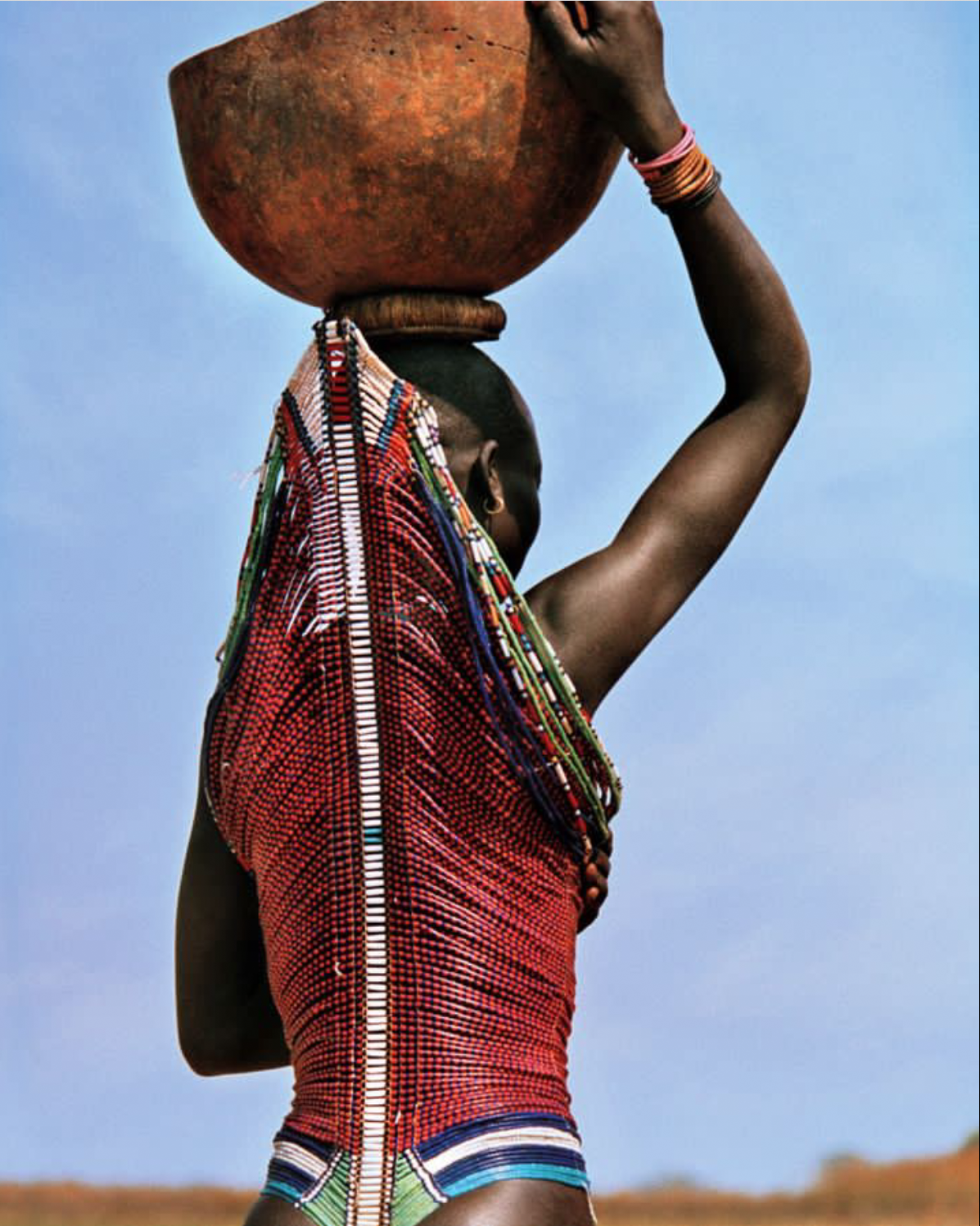
In “African Ceremonies” a comprehensive selection of images covering more than 30 years of fieldwork carried out by U.S. born Carol Beckwith and Australian Angela Fisher, two photographers who have dedicated their lives to recording traditional cultures throughout Africa. Together, they produced a book of artistic excellence that has vividly captured various aspects of Dinka identity, culture, and way of life. In a sense, they have also documented the culture of a people whose world is transforming rapidly. The book presents the Dinka as they were at a time of relative stability and continuity, with an eye for dramatic beauty. They have appropriately focused on the core of Dinka culture and life – their devotion to cattle. Their work captured some of the best of Dinka sacred ceremonies specifically the Dinka beaded adornment. “The size and beauty of a corset reflects whether the wearer comes from a family rich in cattle and can afford a high bride price. Some women from wealthy families also wear beaded corsets. The height of the corset in the above photograph indicates the girl’s parents require over 80 head of cattle in exchange for her hand in marriage.”
In 1983, a civil war erupted in Sudan, pitting the largely Arab and Muslim northern Sudan against the black African peoples of the south. Lasting until South Sudan’s declaration of Independence in 2013, the war had dire consequences for the Dinka and other Nilotic peoples. Hundreds of thousands of Dinka have died while countless others became refugees. The war experiences and their effects on the society are documented in the movie Lost Boys of Sudan. The Dinka now live in a large region that forms a swampland when the Nile River floods during the rainy season. Climate change has caused floods to worsen over the last three years. Due to civil war and flooding, large numbers of Dinka have migrated from South Sudan to Kenya, Uganda, Europe, and the United States as refugees. On April 15, 2023, fierce fighting began again in Sudan and has compounded the crisis across the country. It appears the world has turned a deaf ear as there is little to no coverage of the current situation. It seems the media have mischaracterized the reason behind the eruption of the war, and there has not been much attention from the international community, nor an attempt to envision Sudan’s path forward. According to Dirdeiry M Ahmed, a former foreign minister of Sudan in an article, The war in Sudan is a consequence of a derailed transition; “Two hundred days into the war in Sudan, the Sudanese people remain trapped in a conflict not of their own making. More than 9,000 civilians have been killed and 5.6 million forced to flee their homes, while the capital, Khartoum, continues to be ravaged by savage internecine warfare. Meanwhile, the world’s attention is gradually shifting elsewhere.” So many civilians have been displaced and many specifically women and girls are being raped and yet the international community have done nothing.
Here are a few NGOs doing work on the ground and will be shared via our social media pages as well.
If you know of any good NGOs, do share with us.
ISLAMIC RELIEF USA
Sudan is the first country the Islamic Relief global family provided relief to by responding to famine in 1984. Since then, Islamic Relief USA has worked to provide humanitarian aid in the region as permitted by U.S. law. Recent aid has included emergency response to flood survivors, as well as food aid.
PLAN INTERNATIONAL
Plan International has been working in Sudan since 1977. Their work supports vulnerable children and young people to reach their potential in safe communities that respect their rights and gender equality. Plan International’s main priorities in Sudan are: education, keeping children safe, health and early childhood development, skills and job opportunities for young people, participation of children in society, water and sanitation, and responding to disasters and crises.
SAFERWORLD
Saferworld began its work in Sudan in 2011. They support civil society organizations to undertake research, policy and influencing work. Saferworld provides space and opportunities for civil society to come together to discuss how to further peace and democracy. They also help civil society organizations to raise public awareness of conflict and governance issues and promote debate.
SUDANESE PROFESSIONALS ASSOCIATION
The Sudanese Professionals Association traces its roots to October 2016, when an alliance charter was drafted and approved by three of Sudan’s largest professional groups. Namely, The Central Committee of Sudanese Doctors, The Sudanese Journalists Network, and The Democratic Lawyers Association.
The Sudanese Professionals Association (SPA) is a continuation of the long history of Sudanese professionals’ persistent attempts to form independent trade unions and bodies to defend their rights and seek to improve their working conditions. Several attempts to form such bodies were made in the past; most notably the attempts to form a professional alliance in 2012 and 2014. Both failed to achieve their goal because of the regime’s opposition which extended to the persecution and arrest of key founding members.
The SPA is currently comprised of many bodies united under an agreed upon charter and common goals. These were announced in June of 2018. A large number of professional bodies declared their backing of the SPA, while they await to formally join.
Getting There: Visit our African Homecoming page — a page dedicated to African history, Africa’s great civilizations, people, places, history, culture, and traditions and uncover the untold stories of the diverse and vast African continent. Encompassing a wide range of experiences, the page is inspired by our travelers who are cultural ambassadors, erudite for ebullient discussions, gluttons for authentic cultural experiences and stories, with an inveterate passion for travel. We’re always here to take the guesswork out of your travel experiences to the African continent – experiences that shift perspectives and fuel imagination.


